
What affects your Credit Score?
Understanding Your Credit - Knowledge Is the First Step Toward Better Credit Decisions
Your credit history can influence important financial opportunities, including financing, housing, and certain other transactions.
Understanding how credit reports and credit scores work can help you identify potential reporting errors, manage credit responsibly, and make informed financial decisions.
Credit Repair Circle provides credit education, credit report analysis, and assistance with legitimate credit reporting disputes.
What Is a Credit Score?
A credit score is a numerical estimate of credit risk based on information in a consumer’s credit report.
Many commonly used credit scoring models produce scores ranging from 300 to 850, although other scoring ranges also exist.
Generally, higher scores indicate lower predicted credit risk.
Lenders may consider credit scores alongside income, debt obligations, employment, collateral, and other factors when evaluating applications.
A credit score does not guarantee approval or determine the interest rate a consumer will receive.
Different lenders may use different credit scoring models, which means your scores can vary depending on the model and credit bureau information used.
What Factors Affect Your Credit Score?
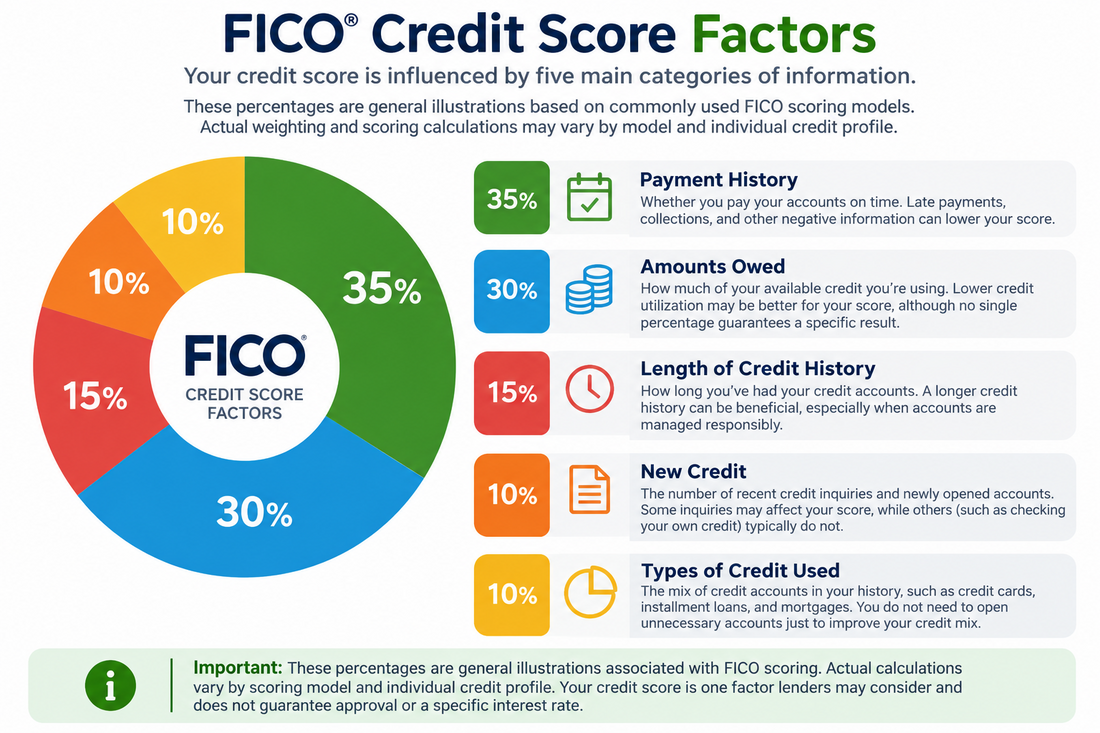
Many FICO scoring models consider five broad categories of information.
Payment History — Approximately 35%
Payment history reflects whether accounts have been paid according to their terms.
Late payments, collections, and certain other negative account information may affect credit scores.
The impact depends on the scoring model and the consumer’s overall credit history.
Amounts Owed — Approximately 30%
This category considers outstanding debt and how much available revolving credit is being used.
Credit utilization is commonly calculated by dividing a credit card’s reported balance by its credit limit.
Lower utilization may benefit credit scores, although no single utilization percentage guarantees a particular result.
Length of Credit History — Approximately 15%
Scoring models may consider the age of your oldest and newest accounts, the average age of accounts, and other aspects of account history.
A longer, responsibly managed credit history can be beneficial.
New Credit — Approximately 10%
Recent credit applications, newly opened accounts, and certain credit inquiries may influence credit scores.
Not every inquiry affects a credit score.
For example, checking your own credit report is generally considered a soft inquiry and does not lower your score.
Credit Mix — Approximately 10%
Credit mix refers to the different types of credit accounts in a consumer’s history, such as credit cards, installment loans, and mortgages.
Consumers do not need to open unnecessary accounts simply to improve their credit mix.
These percentages are general illustrations associated with FICO scoring. Actual calculations vary by scoring model and individual credit profile.
How Can You Build and Maintain Healthy Credit?
Make Payments on Time - Payment history is an important factor in many credit scoring models.
Paying accounts according to their terms can help establish a positive payment history.
If you’re experiencing difficulty making payments, contact your creditor to discuss available options.
Manage Credit Card Balances
Credit utilization can influence credit scores.
Using less of your available revolving credit may be beneficial, particularly when balances are reported to credit bureaus.
There is no universal 30% threshold that guarantees a particular score.
Review Your Credit Reports
Reviewing your credit reports can help you identify potential inaccuracies, unfamiliar accounts, and other reporting concerns.
You can obtain free credit reports from the nationwide consumer reporting agencies through AnnualCreditReport.com.
Apply for Credit Thoughtfully
Opening several new accounts within a short period may affect your credit profile.
Consider your financial needs and the terms of each product before applying.
Maintain Accounts Responsibly
The age and history of credit accounts may influence credit scores.
Before closing an account, consider potential effects on available credit, utilization, fees, and your overall financial circumstances.
Understanding Credit Report Disputes
Federal law gives consumers the right to dispute information they believe is inaccurate or incomplete.
Examples of potential reporting concerns include:
Accounts that do not belong to you.
Incorrect payment histories.
Duplicate reporting of the same debt.
Incorrect balances or account statuses.
Information that has exceeded applicable reporting periods.
Accounts associated with identity theft.
Consumers may submit disputes directly to consumer reporting agencies at no cost.
Credit Repair Circle offers education, report review, and administrative assistance to consumers who prefer additional guidance.
We cannot guarantee that a dispute will result in deletion, a credit score increase, or any other specific outcome.
How Long Does Negative Information Remain on a Credit Report?
Different types of information are subject to different reporting rules.
Late Payments
Late payments generally may remain on credit reports for up to seven years from the date of the delinquency.
Collection Accounts
Collection accounts generally may be reported for approximately seven years from the original delinquency that led to collection, subject to applicable statutory rules.
Selling or transferring a debt generally does not restart the federal credit reporting period.
Charge-Offs
Charge-offs generally follow the applicable reporting period associated with the delinquency that led to the charge-off.
A charge-off does not necessarily mean the debt is forgiven.
Closed Accounts
Accurate positive closed accounts may remain on credit reports for years after closure.
Negative information associated with closed accounts remains subject to applicable reporting limits.
Closing an account does not automatically erase its payment history.
Bankruptcy
Chapter 7 bankruptcies may generally remain on credit reports for up to ten years from filing.
Chapter 13 bankruptcies are generally removed by the nationwide credit reporting agencies after seven years, although federal law permits certain bankruptcy information to be reported for up to ten years.
Credit Inquiries
Hard inquiries generally remain visible on credit reports for approximately two years.
Their scoring impact varies by scoring model, and many FICO models consider qualifying inquiries for only twelve months.
Soft inquiries generally do not affect credit scores.
Tax Liens and Civil Judgments
The three nationwide consumer reporting agencies generally do not include civil judgments or tax liens on standard consumer credit reports under their current reporting practices.
This does not necessarily mean that the underlying obligations no longer exist.
Medical Debt
Medical debt reporting is subject to specific laws and industry reporting practices.
The nationwide credit reporting agencies have adopted policies that exclude certain medical collection accounts, including paid medical collections and qualifying smaller balances.
Applicable requirements and reporting practices may change.
Your Rights Under Federal Credit Reporting Law
The Fair Credit Reporting Act provides important consumer protections concerning the accuracy, fairness, and privacy of credit reporting information.
Depending on the circumstances, consumers may have the right to:
Obtain copies of their credit reports.
Dispute inaccurate or incomplete information.
Receive information about certain adverse decisions based on credit reports.
Request fraud alerts or security freezes.
Seek correction of qualifying identity theft information.
Pursue available remedies when their rights are violated.
Consumers can dispute credit reporting errors directly without hiring a credit repair company.
How Credit Repair Circle Can Help
Understanding your credit report is an important part of making informed financial decisions.
Credit Repair Circle can help you review your credit information, recognize potential reporting concerns, and understand available dispute procedures.
For consumers who prefer additional assistance, we offer information about our credit-related services and the steps involved.
We may also recommend third-party credit monitoring products, including IdentityIQ. Such products may require a separate subscription, and Credit Repair Circle may receive referral compensation for qualifying purchases.
Any applicable affiliate relationship will be disclosed in connection with the recommendation.
Start With a Free Consultation
Have questions about your credit reports or credit reporting rights?
Contact Credit Repair Circle to discuss your concerns and learn about your options.
REQUEST YOUR FREE CONSULTATION


